
- /
- By Blog Admin
Artificial intelligence is being discussed as one of the biggest productivity opportunities of our time. Businesses are adopting generative AI, employees are experimenting with AI tools, founders are rebuilding products around large language models, and investors are looking for the next major AI opportunity.
Yet beneath all this excitement is another reality:
AI anxiety is rising.
And it is not limited to employees worried about job losses. Founders feel it. Investors feel it. Technology leaders feel it. Even people who are building AI products every day feel it.
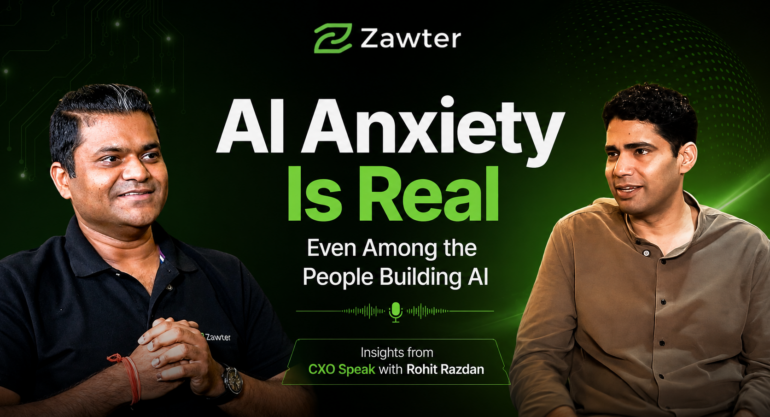
That was one of the strongest themes in a recent episode of CXO Speak, where Arun Aggarwal spoke with Rohit Razdan, Co-founder and CEO of Synaptic, about AI adoption, business disruption, investor uncertainty, AI costs, hiring and the future of work.
One line from the conversation captures the moment well:
“AI means that we are all at zero.”
That idea is both exciting and uncomfortable.
AI is creating new opportunities, but it is also weakening advantages that companies spent years building.
Why AI Anxiety Feels Different
Businesses have navigated technology revolutions before: personal computers, the internet, mobile, cloud computing and digital transformation.
What makes the current AI shift different is the speed of change.
In the podcast, Rohit explains that AI capabilities are evolving so quickly that even informed people struggle to know where the market is heading. A strategy that looks sensible today may become outdated within months.
That creates a different kind of uncertainty.
The question is no longer only:
“What is happening?”
It is:
“What happens next?”
And even sophisticated investors do not have a clear answer.
Investors Have AI Anxiety Too
Rohit works closely with venture capital and private equity firms, giving him visibility into how investors are thinking about AI.
These firms have access to extensive information, founders, market data and emerging technology trends. Yet many are still uncertain about where value will ultimately accumulate.
Will the winners be foundation model companies?
AI infrastructure providers?
Application-layer startups?
Enterprise software companies?
AI agents?
Vertical AI businesses?
The challenge is that each of these assumptions can change quickly.
That uncertainty creates AI anxiety at the investor level. It also creates pressure to move quickly, which can lead to overvaluation, exaggerated claims and what is increasingly being called AI washing.
Founders Are Asking: “What Am I Missing?”
For founders, AI anxiety is often less about whether they should adopt AI.
Most already know they should.
The bigger fear is:
“What opportunity am I missing?”
AI can dramatically change how a business creates value.
A founder may ask:
Could AI help us serve a larger market?
Could we deliver the same service at a lower cost?
Could a competitor rebuild our product faster?
Could customers build the solution themselves?
Could our core product become just another feature?
This is why AI FOMO is becoming so common.
The concern is not irrational. The underlying technology is changing rapidly enough that companies really can lose an advantage faster than before.
AI Is Challenging the SaaS Model
One of the most interesting ideas in the podcast is how AI could change the traditional Software-as-a-Service model.
Historically, the SaaS playbook was simple:
Find a customer pain point, build software to solve it, and charge for the solution.
But AI introduces a new possibility.
What if the customer can build the solution?
Customers often understand their own pain points better than software vendors. They know their workflows, internal processes and requirements. Previously, they may not have had the technical ability to build software themselves.
Generative AI is reducing that barrier. For SaaS companies, the strategic question is becoming:
“What value can we provide that customers cannot easily recreate with AI?”
That could mean moving higher up the value chain through proprietary data, workflow integration, trust, domain expertise, insights or decision support.
Employees Are Facing a Different AI Anxiety
For employees, the fear is more direct:
“Will AI replace my job?”
The podcast suggests a more nuanced reality. AI may change jobs before it eliminates entire professions.
A developer may write less code manually but spend more time designing systems and reviewing AI-generated output.
An accountant may spend less time on repetitive processing and more on analysis and judgment.
A marketer may automate reporting and focus more on strategy.
The important shift is that employees who know how to work with AI may become more valuable. That may also change hiring. Instead of asking whether a candidate knows the answer, companies may increasingly ask:
“Can this person solve the problem using all the tools available?” This is why open-book, real-world problem-solving could become more common in AI-era recruitment.
AI Adoption Has a Cost Problem
Another major theme from the conversation is AI spending. Many companies are focused on AI productivity, but fewer are asking what the technology is costing them.
Businesses are now paying for:
AI subscriptions, API calls, tokens, coding assistants, enterprise AI tools, infrastructure and experimentation. For some technology businesses, AI spending could eventually rival or exceed traditional cloud infrastructure costs.
That means the next phase of AI adoption will not only be about experimentation.
It will be about AI ROI.
Leadership teams will increasingly ask:
Which workflows are creating measurable value?
Do we need the most powerful model for every task?
Could smaller models perform the same work?
How much are we spending per workflow?
Is the productivity improvement worth the cost?
A useful principle from the conversation is simple:
Use the right model, not automatically the biggest model.
The India Question
For India, the AI conversation is particularly important.
India’s economy has benefited significantly from IT services, outsourcing and technology talent.
AI could improve productivity across these industries.
But it could also reduce the amount of labour required for certain kinds of work.
Even a moderate reduction in services demand could have wider economic consequences.
At the same time, the growth of Global Capability Centres is creating new demand for specialised talent.
So the real issue is not simply “AI versus jobs.”
It is whether businesses and workers can move fast enough toward higher-value, AI-enabled work.
AI Anxiety May Be Rational
AI anxiety is often treated as something that needs to be eliminated.
But some of it may be rational.
The technology is evolving rapidly.
Business models are changing.
Jobs are being redesigned.
Investment assumptions are being challenged.
AI costs are rising.
And many long-term consequences remain uncertain.
The right response is not panic, and it is not blind adoption.
It is disciplined experimentation.
Businesses should ask:
Where is AI already creating value?
Which parts of our business are becoming commoditised?
What remains genuinely differentiated?
What are we spending on AI?
Are our employees becoming AI-native?
The winners of the AI era may not be the companies with the biggest AI budgets.
They may be the companies that learn, adapt and redesign themselves faster than everyone else.
If “AI means that we are all at zero,” then the next competitive advantage will come from how quickly we learn what to do from here.
